Stretch is a book written by Scott Sonenshein. Scott Sonenshein is a social scientist at Rice University.
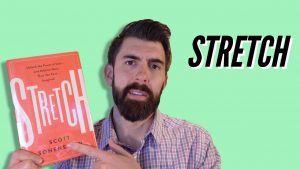
Stretch Book Summary
This book is about how people can succeed with limited resources. In contrast, people that try to always acquire more resources are labeled “chasers” in this book.
What interested me about this book?
I’m somewhat frugal, and I wonder if I have too many options sometimes. I have too much to choose from when trying to grow my business. What item should I focus on first. Do I need to acquire more resources. Should I take another course. Maybe I need to listen to an audiobook or podcast first. Maybe I need a better computer or a better camera. Maybe I need better lenses or a better microphone.
Sometimes we have what we already need, and we just don’t see it.
That’s what I thought this book was about when I picked it up, and I was correct! This book shows people that the chasing mindset can destroy your life and your business.
Another area that I think this book applies to is everyone’s personal life. The author speaks about it briefly in the book, but the american dream is based on chasing. I think people in America would be a lot more happy if they didn’t chase. If they didn’t compare. Sometimes we have all that we need to be happy. It’s not just about happiness either. Sometimes we have what we need to start a business or to start saving. People could save more money from their paychecks if they didn’t chase what they see around them. If they didn’t compare to their friends. I hope you consider the lessons from this book and take a look at what resources you have available to you today to achieve your goals or desires.
10 Top Tips From The Book
Don’t plan so much. You might be planning for a world that doesn’t exist
You don’t always need more resources to solve a problem.
Try to come up with other uses for more things in your life.
Have higher expectations for yourself and others and you might meet them.
Don’t approach the challenges in your life as threats
The best ideas come from the people that have the most ideas.
Let your mind wander sometimes. Change up your tough work with some time to be mindless.
Try to be an outsider and talk to outsiders in order to get more perspective and additional solutions.
Be grateful. People that are grateful use their existing resources better.
If you are an introvert, avoid making big moves in life because it is hard to recover.
My summary and notes from the book are below. Thanks for reading!!!
Chapter 1 – A Tale Of Two Beers
This chapter is the author’s introduction to the book. The author shows that more resources don’t always equal success in this chapter.
He also lays down some pretty important concepts:
1. People routinely overestimate the importance of acquiring resources but significantly underestimate their ability to make more of the resources they do have.
2. Our instincts are that having more resources equals getting better results.
He then tells the story of Dick Yuengling. If the name sounds familiar, it is because it is also the name of a famous beer. Dick Yuengling grew his brewery to be the largest domestic brewery despite limited resources. He had a factory that was 150 years old. He didn’t do large acquisitions like other breweries.
He contrasts the story of Dick Yuengling to Stroh Brewery which was a failure. Stroh brewery was started in 1849 by German immigrants. At its peak they made 31 million barrels a year. They were the 3rd largest brewery in the nation. The grandson Peter Stroh took over the brewery in 1967. It failed because the grandson was obsessed with growth and acquisition. The company constantly took out debt to grow and acquire companies. Ultimately it took on too much debt and couldn’t succeed. At its peak it was worth $9 billion.
The comparison between Yuengling and Stroh shows two companies in the same industry. One took a more conservative approach to using resources and another was super aggressive. You need to learn how to be creative with the resources you already have instead of always chasing more resources and increasing your expenses.
Chapter 2 – The Grass Is Always Greener
This chapter is about the psychological foundations of chasing.
The author spoke about something that I definitely identified with in this chapter. He said that we work way too much to buy stuff that we don’t need. To highlight this, the author provides a story about a chocolate study where people pushed a button to get chocolate. The Univeristy of Chicago conducted a study where people listened to music.
People could earn dove bars by doing a little work: they had to press a button. Pressing the button also interrupted their leisure music. The people conducting the study also labeled some participants as high earners. As high earners, the participants could press a button twenty times to get a dove bar. Low earners had to press the same button 120 times to get the same payout.
Participants were told they could not take any chocolates with them. High earners ended up with 10.7 chocolates and low earners ended up with 2.5 chocolates. After they were told they could consume the chocolates, high earners ate 4.3 chocolates compared with 1.7 for low earners. Both groups acquired more chocolate than they thought they could. In a follow up study they capped the amount of chocolates people could earn to 12 chocolates. In the past people tried to acquire 14+ chocolates. After the cap, participants only acquired on average about 8.8 chocolates.
What this shows is that we often work to achieve more things than we actually need.
A different study is highlighted in this chapter regarding children’s use of resources. One group of children were provided their resources in a box. The other group of children were provided resources outside of the box. The children that were only provided resources in the box viewed the box as a container. The children who were provided resources outside of the box viewed the box as another tool that they could use to come up with a solution.
It’s easy to try to solve problems with more money. Think of silicon companies that use their funding to pay for marketing. It works for a little bit to build awareness, but if there is nothing unique about the company, then the companies go around because of too many expenses. Don’t make a habit of always seeking more money and more resources.
Chapter 3- The Basics And Benefits Of A Stretching Mindset
In this chapter the author covers some people that stretched their mindset and benefited from it.
He first goes over a story of a boutique chain that allowed their employees to have ownership over how they sold items in the store. This ownership allowed employees to view regular items in a different light. One employee saw a dress that wasn’t selling and cut off the straps. Then he relabeled that item as beachwear, and it started flying off the shelves.
The conclusion from that story is that the more ownership you take over something, the more likely you are to be creative. That insight was more based towards business from what I can tell.
Another cool thing about this chapter that was a huge tip for me was that constraints enable creativity. As I said in the intro, sometimes we have too many options to choose from. This creates analysis paralysis. You only see an item for its face value. If you are limited in your resources though, you begin to become more creative.
The author provides an example of this with a story about a lady who made jams and chutneys from fruits that were blemished. There was nothing wrong with the fruits; people just don’t want to buy fruit with blemishes on them at the grocery store.
The last story that the author provides in this chapter was a story about the CEO of Fastenal. I’ve heard of Fastenal before, but I didn’t realize that the company was run so well. The CEO was very frugal. The CEO wouldn’t pay for meals while traveling because he said that employees had to eat anyway. All of his company’s office furniture was second-hand. You think this would be less motivating to employees, but it wasn’t. I think it showed the employees that the CEO was invested and cared about his business. This probably motivated them to work for a motivated and invested owner. All this frugality didn’t lead to the company going down the hole. Nope. The company grew by 47,782%. Just because he was frugal did not mean that he wouldn’t invest in his company. He just didn’t invest in frivolous things that most growth based companies invest in.
Chapter 4 – Get Outside: The Value Of Knowing A Little About A Lot
This chapter is about how the breadth of your experience can help you solve hard problems. In other words if you have a lot of experience in different things, you can better utilize resources.
Our society is so obsessed with specialization that people get discouraged from trying to solve difficult problems, but the author shows that you shouldn’t let that hold you back.
He provides the story of Gavin Potter who almost won the Netflix $1 million prize for decoding the napoleon dynamite recommendation algorithm. Gavin did very well in this contest even though he didn’t have any coding experience. He used his knowledge of human psychology to help improve the Netflix algorithm. He didn’t have computing power, but he still persisted.
Outsiders outshine experts because experts see things at face value.
The breadth of people’s experience helps them stretch. According to some Eli Lilly’s data from Innocentive, the further a problem is from a person’s area of expertise, the more likely they are to solve it. Innocentive is a crowdfunding platform that pays people for coming up with solutions to complex problems.
Chapter 5 – Time to Act: Sometimes We Perform Better Without A Script
This chapter is all about how sometimes we plan too much. I like this chapter because I’m not a big planner.
The story in this chapter that I related to was about Robert Rodriguez. Robert Rodriguez is a well-known director. He directed the desperado and the spy kids movies. Before that though, he directed a movie called the Mariachi. He did it on barely any budget and little planning.
The author says don’t spend so much time planning. You might be planning for a world that doesn’t exist anymore. I agree with this. I love the financial independence movement. However, I think the FIRE movement sometimes focuses on planning way too much. Sometimes you might have enough money to pursue your dreams, and you don’t even realize it. You might be saving too much money because you are planning for all the what-ifs. You plan for so many bad scenarios that you forget the real reason you started saving money in the first place. Maybe you started saving money to pursue your dreams, but you end up saving money so that you can live a luxurious and lazy retirement.
Our desire for planning comes from a trade-off that we regularly think we need to make – speed versus accuracy.
We have 2 regulatory modes planning and acting. When people plan, they often second guess themselves. If you are a planner, and you feel worried all the time, this could be the reason why.
Chapter 6 – We Are What We Expect
This chapter is about how are beliefs shape us. We often fit others’ expectations of ourselves. There are some good stories in this chapter.
1. One story in this chapter is about the Bank of the United States. The Bank of the United States went under because people spread rumors that it was going under.
2. Another story in this chapter is about the first african american woman C.J. Walker.She started her business during a period of extreme racism. She started hair products for African American women. She didn’t think of herself as being held back by society, so she pursued her business and became a millionaire. She had high expectations for herself.
3. The last notable story in this chapter is a story about a horse. Its owner would ask it math questions, and it would respond with the correct answer by tapping its hoof. People wondered how it could answer correctly. It turns out that people would get excited when the horse hit the right answer which cued the horse to stop tapping. This shows that expectations can shape us and others.
Don’t approach your challenges as threats because it produces rigidity. Raise your expectations of yourself.
Chapter 7 – Mix It Up: The Power of Unlike Combinations
This chapter is about using different resources to come up with better solutions. This includes your identity.
We all have multiple identities. We have personal identities and professional identities. You can use your personal knowledge at work to come up with better solutions.
People want to put things in little buckets, but everything in the world isn’t neatly categorized. Things often mix together. Different things can coexist in harmony. You don’t have to be a bad employee in order to be a good family member.
The story in this chapter is about Goodyear tires. The founder started out trying to create mailbags, but they kept breaking. He was coming up with solutions in the rubber craze of the 1800’s. He kept persisting though. He eventually found a good rubber formula in his own kitchen. He kept persisting even though he had many failures and came up with a rubber that could last in hot and cold conditions.
Chapter 8 Avoid Injuries: How To Get The Right Stretch
This chapter is obviously about how to prevent injuries from overstretching.
According to the author, there are 5 common injuries from overstretching. They include:
1. Turning into a cheapskate
2. Wandering on the road to nowhere
3. Leaping without learning
4. Being cursed with high expectations
5. Making toxic mixtures
All virtues can become vices when they are taken to the extreme.
Stretchers should be frugal and not cheap.
Don’t overstretch yourself. You will blow yourself out.
Chapter 9 – Workout
This chapter is basically just a recap of the previous chapters. The author recommends exercises for people to complete in order to learn how to stretch.
The author recommends being grateful. People that are grateful they are less economically impatient. In other words, they believe they can use their resources better.
- Make a new year’s resolution any time of the year. Making a new year’s resolution makes it 10x more likely that you will make a positive change in your life.
- Make sure to change up your routine every now and then. That way you can look at things from different angles.
- Hang out with people outside your area of expertise and learn a new field.
- Let your mind wander sometimes. Don’t always be busy. Studies show that it’s good to rotate between mindful work and mindless work.
