Ultralearning is a great book for anyone that wants to learn a skill or subject that is hard to master. Scott wrote this book after becoming famous for completing an MIT college degree without going to MIT. He studied the materials and passed all the classes and tests in under a year. Can you do the same?
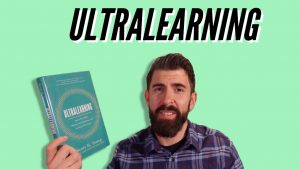
ultralearning
What is ultralearning? Ultralearning is learning a subject by yourself in a shortened time span.
There are some great techniques here. From a high level standpoint, Scott teaches people that you can break learning down into planning, direct learning,drilling, testing and feedback and then retaining the information. I do recommend this book for anyone looking to learn a new subject or skill.
Overall, I’d say this book doesn’t reveal anything too crazy. It just proves that you need to be more mindful of how you learn. If you plan out what you are going to learn, you will be more successful. If you drill skills where you are weak, you will get mastery faster.
How can you use this in your life today? Choose a subject that you want to learn and try to use the ultralearning method to learn that subject. It doesn’t matter what the subject is.
My Favorite Tips From Ultralearning
- Be direct – the best way to learn is by being direct. For example, if you want to learn a language, then you should practice conversation as much as possible versus using an app like Duolingo.
- Try different levels of arousal when studying – There are also other good tips such as trying different levels of stimulation while studying. Some subjects are just way too boring, so you want to study those subjects in a place with more arousal like a coffee shop.
- How to take notes when learning – There was good information about note taking in this book. He recommends taking notes after learning a section or just free write and try to recall as much information as possible so that it sticks. You should also try to write your notes in the form of questions so that you can drill yourself on the information later on.
- Psychology Tips – There’s also some good positive psychology tips here. You have to believe that you can learn and that anything can be learned. You can’t view learning as finite. You shouldn’t believe that you stop learning at a certain point in your life. If you are reaching a barrier in your learning, you should use your intuition and experimentation to break out of that barrier.
My General Notes From Ultralearning
chapter 1 – can you get an MIT education without going to mit – he talks about his mit challenge where he tried
chapter 2 – why ultralearning matters – what is ultralearning – a strategy for acquiring skills and knowledge that is both self-directed and intense
tuition is too high, so you need to be able to teach yourself without going to an expensive college.
average is over – you can’t be average and expect to have above average results anymore bc of technology
you can learn by
1.new part time projects
- learning sabbaticals,
- and reimagining existing learning efforts
Chapter 3 – how to become an ultralearner
- metalearning: first draw a map – start by learning how to learn the subject or skill you want to learn
- focus: sharpen your knife – cultivate the ability to concentrate
- directness:go straight ahead – learn by actually doing the things you want to be good at
- drill: attack your weakest point – break down skills into small parts and then be good at those small parts
- retrieval: test to learn – test yourself before you feel confident
- feedback: don’t dodge the punches – feedback is harsh and uncomfortable
- retention : don’t fill a leaky bucket – understand what you forget and why
- intuition: dig deep before building up – understand how understanding works
- experimentation: explore outside your comfort zone
chapter 4 – principle 1 – metalearning: first draw a map
why are you learning the subject. talk to people that have already learned the subject
Write out your metalearning plan into 3 columns – what, why and how(procedures)
what – concepts, facts, and procedures
concepts are ideas that you need to understand in flexible ways. these are things that need to be learned and not memorized.
For example, law uses facts
in second column write down anything that needs to be memorized. these are facts. you don’t need to understand these deeply
procedures – in the third column write down anything that needs to be practiced
how much planning to do – it should take like 10% of the total time of the project
chapter 5 – principle 2 – focus: sharpen your knife
distraction source 1 – your environment – turn off your phone, tv etc. don’t multitask
distraction source 2 – your task – certain things are harder to learn
distraction source 3 – your mind – if you are struggling with things in your life you will struggle to learn
try different levels of arousal for learning. some tasks require more arousal to keep you engaged.
chapter 6 – principle 3 – directness: go straight ahead
how to learn directly
tactic 1 – project based learning – organize your learning around building something
tactic 2 – immersive learning – surrounding yourself with the target environment.
tactic 3 – the flight simulator method – when direct practice isn’t practical do the next best thing which would be like a simulator
tactic 4 – overkill method – go way overboard
chatper 7 – drill: attack your weakest point
how to drill
drill 1 time slicing – develop skills for sets of time
drill 2 cognitive components – drill different components
drill 3 copycat – copy parts of a skill that you want to drill – draw from photos
drill 4 – the magnifying glass method – spend more time on one component than normal
drill 5 prerequisite chaining – start with a skill you dont have prerequisites for – go through a chaing of things you need to learn and go back to the start if you fail
chapter 8 – principle 5 – retrieval: test to learn
tactic 1 – flash cards
tactic 2 – free recall – try to write down everything that you remember after you read or learn something
tactic 3 – the question book method – write questions for yourself after studying something. this makes it harder. make sure the questionsare good though.
tactic 4 – self generated challenges
tactic 5 – closed book learning – don’t open book
chapter 9 – principle 6 – feedback
you need feedback
informational feedback
chapter 10 – principle 7 – retention
what are the ways to retain things learned?
- spacing – spacing out the time that you learn things. Don’t cram
- proceduralization – like riding a bike. Things like riding a bike or driving a car are easier to remember so try to do the same with whatever you are learning.
- overlearning – continually practicing the skill or advanced practice whis is going one level above your current level.
- mnemonics – using visuals and spatial mapping to memorize digits and vocab recommends walking with einstein
chapter 8 intuition
gives example of feynman as genius but shows that feynman had great math intuition.
how to build intuition
- don’t give up on hard problem easily – difficulty helps you remember
- prove things to understand them – try drawing a bike or a can opener from memory. can you do it? seems easy but it’s not.
- always start with a concrete example
- don’t fool yourself
feynman technique – write a concept or problem down – explain it as if you had to teach it or explain how to solve it. if you can’t explain it, go back to the source material until you can explain without resorting to the source material.
Chapter 9 experimentation
experimentation is key to mastery. Abilities stagnate after you master the basics.
3 types of experimentation
- experimenting with learning resource
- experiment with technique
- experiment with style
how to experiment
tactic 1 – copy, then create – copy someone better, deconstruct their methods
tactic 2 – compare methods side by side
tactic 3 – introduce some new constraints – artists w/ too many options are a mess. reduce your options
tactic 4 – find your superpower in Hybrid unrelated skills – he refers to scott adams here because scott adams discusses this in his book about how to fail at almost everything and still win
