The Myers Briggs test also known as the mbti instrument was developed by Katharine Cook Briggs and Isabel Myers. Katharine Cook Briggs was Isabel Briggs Myers’ mother. They developed the test based on work performed by Carl Jung and theory of psychological types. Carl Jung believed that you could categorize people based on personality types which is what the MBTI focuses on categorizing.
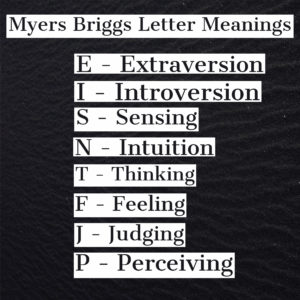
myers briggs letter meanings
They found out about his theories in 1923. Personality types are determined by categorizing information about yourself into 4 letter determinations. The listing of MBTI letters are below.
E – extraversion
I – Introversion
S – Sensing
N – Intuition
T – Thinking
F – Feeling
J – Judging
P – Perceiving
Each letter of the Myers Briggs test is a psychological preference. They are also grouped in pairs.
The first pair of MBTI letters is E and I which stand for extraversion and introversion.
Extraversion – Extraversion and introversion were terms used by C.G. Jung. It explains how people direct their energy. You can’t think of extraversion as the way we use it in everyday terms. Even though someone might be socially outgoing, they might not get their energy from doing outgoing activities. There are plenty of people that are introverted in society who can still function socially. It’s all about where you get your energy from. If you tends towards extraversion, then you get your energy from group activities and social activities.
Introversion – The introverted person prefers to get their energy from themselves. They get their energy from ideas, pictures, memories and reactions inside their own head.
Try to think about what you do more. Do you get your energy from people or do you get your energy from your own thoughts. It will probably only take you a couple seconds to figure this out. People with an introversion psychological preference also sometimes like their own ideas better than the real thing. To me it seems like people with an introversion preference would be the artists of the world because their ideas would be huge and bigger than real life.
The next pair of MBTI preferences is sensing and intuition.
The sensing and intuitive preferences relate to how you process the information that you receive. I think of the sensing and intuitive preferences as the way you learn.
Sensing – If you lean towards the sensing preference then you tend to download information through your five senses. Another clue that you might lean towards the sensing preference is if you do things by experience. You might also be really into the facts and look at the bottom line.
Intuition – People that lead towards intuition think more about the future than the past. People with intuition learn by thinking things through rather than relying on facts.
The next pair of mbti preferences are Thinking and feeling. These two mbti letters describe how you make your decisions.
Thinking – If you use thinking to make your decision, you consider the pros and cons of the situation and do not involve your own feelings in the decision. You seek to be fair in your decision-making.
Feeling – If you use feelings to make your decisions you tend to consider the people involved in the situation and what is best for them. You tend to lean towards people and communication when making your decisions. You seek to maintain harmony between all the parties involved in the decision. You tend towards pleasing the parties involved instead of being up-front or confrontational.
The last pair of Myers Briggs letters are judging or perceiving.
This set of preferences relates to your orientation to the external world. In other words its how you interact with the outer world. To determine whether you are judging or perceiving you have to look at the way that you structure the world.
Judging – People that like to make decisions when they interact with the external world. They like to have things decided and bring things to a close. You might say that these people are decision based when it comes to their approach to the external world.
Perceiving – People that are perceiving prefer a flexible and spontaneous approach to the outer world. They adapt to the situation at hand. They stay open to new experiences and when it comes to making decisions they like to keep their options open. These people may appear to be indecisive and fluid. They can also be less consistent than judging preference types.
Meyers Briggs explanation
The MBTI stands for Myers Briggs type indicator. The type indicator means what type of personality category you fall into. You can figure this out by taking the MBTI test and then figuring out which 4 MBTI letter categories you fall into. Because there are four letter categories that you can fall into, this means that there are 16 personality type possibilities that everyone can fall into. You typically take the MBTI personality type test when you are going through career counseling or through your therapist. You can take the MBTI test for free, but it’s not as likely to be as accurate as a test you would take with a mental health professional. The mental health professional and/or career counselor is going to be able to walk you through the test in a thorough manner.
The 16 personality types are listed below.
- ISTJ
- ISFJ
- INFJ
- INTJ
- ISTP
- ISFP
- INFP
- INTP
- ESTP
- ESFP
- ENFP
- ENTP
- ESTJ
- ESFJ
- ENFJ
- ENTJ
ESTP meaning
Estp means that they are extraverted, sensing, thinking and perceiving. 16 personalities estp profile labels this personality type as the entrepreneur. I think of it more as a celebrity and entrepreneur. An ESTP is not going to be your typical quiet entrepreneur. They are going to be the loud, adventurous entrepreneur that’s open to new ideas constantly.
E means they tends towards extraversion for their energy which means they tend to get their energy from other people. Sensing means that they are more factual when it comes to decisions. Thinking means they aren’t afraid to call it how it is. Perceiving means that they are open when it comes to decision making.
ESTP’s are also very competitive and are often impulsive.
ESTP Strengths and weaknesses – ESTPs strenghts are that they are very factual and outspoken. Their downside is that they are impulsive and competitive. They might offend sensitive people with their approach to work, and their inability to make quick decisions might also stir up problems if they match up with introverted and judging personality types.
ESTP careers – ESTP career matches include anything that involved speaking out while staying open. I think most ESTP’s would do well in creative jobs as executives. I think of things like a film executive or a celebrity that manages their own brand. ESTP’s will want to find a career that doesn’t require tons of planning or procedure since they are judging types.
ESTP Celebrities – Some well known ESTP famous people are jack nicholson, eddie murphy, donald trump, ernest hemingway, Geoge W. Bush, Malcom X, John Elway, Dan Marino and Al Capone.
As you can tell from Donald Trump being on the list is that ESTP’s are very outspoken.
The Myers Briggs type percentages for ESTP’s in the workplace as managers, administrators or supervisors is 3.29% which shows that they are a low percentage of office workers. This makes sense to me since they are very outspoken yet they aren’t very decisive.
ENTJ Meaning
Estp means that they are extraverted, intuition, thinking and judging. 16 personalities estp profile labels this personality type as the commander. I think of it more as a celebrity and entrepreneur. An ESTP is not going to be your typical quiet entrepreneur. They are going to be the loud, adventurous entrepreneur that’s open to new ideas constantly.
ENTJ Careers – ENTJ do well as leaders in whatever industry they choose. They should tend towards careers that involve being outspoken and being around people since that is where they get their energy. They might struggle as low-level employees though.
ENTJ Celebrities – ENTJ famous people include Steve Jobs, Harrison Ford, Gordon Ramsay, Margaret Thatcher and Franklin Roosevelt. All of these people are very outspoken and decisive. They are also big thinkers.
The Myers Briggs type percentages for ENTJ’s in the workplace as managers, administrators or supervisors is 10.63% which makes sense since they are most likely to be leaders. It also makes sense that they aren’t as high as ISTJ’s or ESTJ’s since they are more outspoken and more intuitive.
